


MapYourDreams • County Kerry • Wild Atlantic Way
Dingle Ireland Posters
& Kerry Travel Prints
from the Edge of Europe
Original art from Slea Head, Dunquin Pier, Gallarus Oratory and the harbour — the most westerly and most painterly peninsula in Ireland. Ships worldwide.
15+Designs
1934Paul Henry Legacy
3Formats
🌊Ships Worldwide
Dingle • County Kerry • Ireland

At the Edge of the World — Why Dingle Makes the Finest Irish Travel Posters
Drive west from Tralee through the mountains of Kerry, past the glacial lakes and the grey stone walls, and eventually the road narrows and the land runs out. This is the Dingle Peninsula — An Daingean in Irish, a name that carries in its syllables something of the place’s character: compact, specific, old. From Slea Head, on clear days, you can see the Blasket Islands in the Atlantic and, beyond them, nothing until Newfoundland.
It is, in the most literal geographic sense, the edge of Europe. And edges have a particular quality that artists have always understood: they concentrate experience. Everything the land has to offer — colour, drama, history, the particular Irish relationship between ancient stonework and wild weather — is pressed into a narrow peninsula of perhaps forty kilometres, all of it facing the Atlantic.
The particular light of County Kerry has attracted painters since the 19th century. Paul Henry, the most celebrated Irish landscape artist of the 20th century, produced a travel poster of the Dingle Peninsula for the London Midland and Scottish Railway in 1934 that remains one of the finest pieces of Irish travel art ever made. His particular way with Atlantic cloud and western Irish colour established the visual tradition that all Dingle poster art still works within, consciously or not.
Dingle Ireland Posters — Original Kerry travel prints at MapYourDreams
These prints are for the person who has stood at Slea Head in a south-westerly and understood why the Irish have always treated the Atlantic with a mixture of fear and love. For the diaspora family whose grandparents left Kerry for Boston or Melbourne or London, and for whom a Dingle harbour print on the wall is an act of connection rather than mere decoration. And for anyone who drove the peninsula once, in either rain or sunshine, and has been trying to find the right way to take it home ever since.
Key Takeaways
Dingle Ireland Posters at MapYourDreams — What Sets This Collection Apart
The Edge of Europe
Dingle is one of the most westerly inhabited points of the European continent. These prints carry that geographic specificity in every composition.
Named Locations, Not Generic Ireland
Slea Head, Dunquin Pier, Gallarus Oratory, Mount Brandon — specific Peninsula landmarks, not stock Irish scenery.
The Paul Henry Tradition
1934 railway poster art established the visual language of Kerry travel art. This collection honours that tradition with original contemporary compositions.
The Wild Atlantic Way
The Dingle section of Ireland’s 2,500km coastal route — the most photographed and most emotionally resonant stretch of the entire Way.
For the Irish Diaspora
With 70–80 million people claiming Irish heritage worldwide, Kerry prints carry a personal weight far beyond decoration for millions of potential buyers.
Ships Worldwide
Framed prints, canvas, and unframed posters. UK/Ireland 3–5 days. Worldwide up to 12 days. All tracked.
Dingle • Landmark Subjects

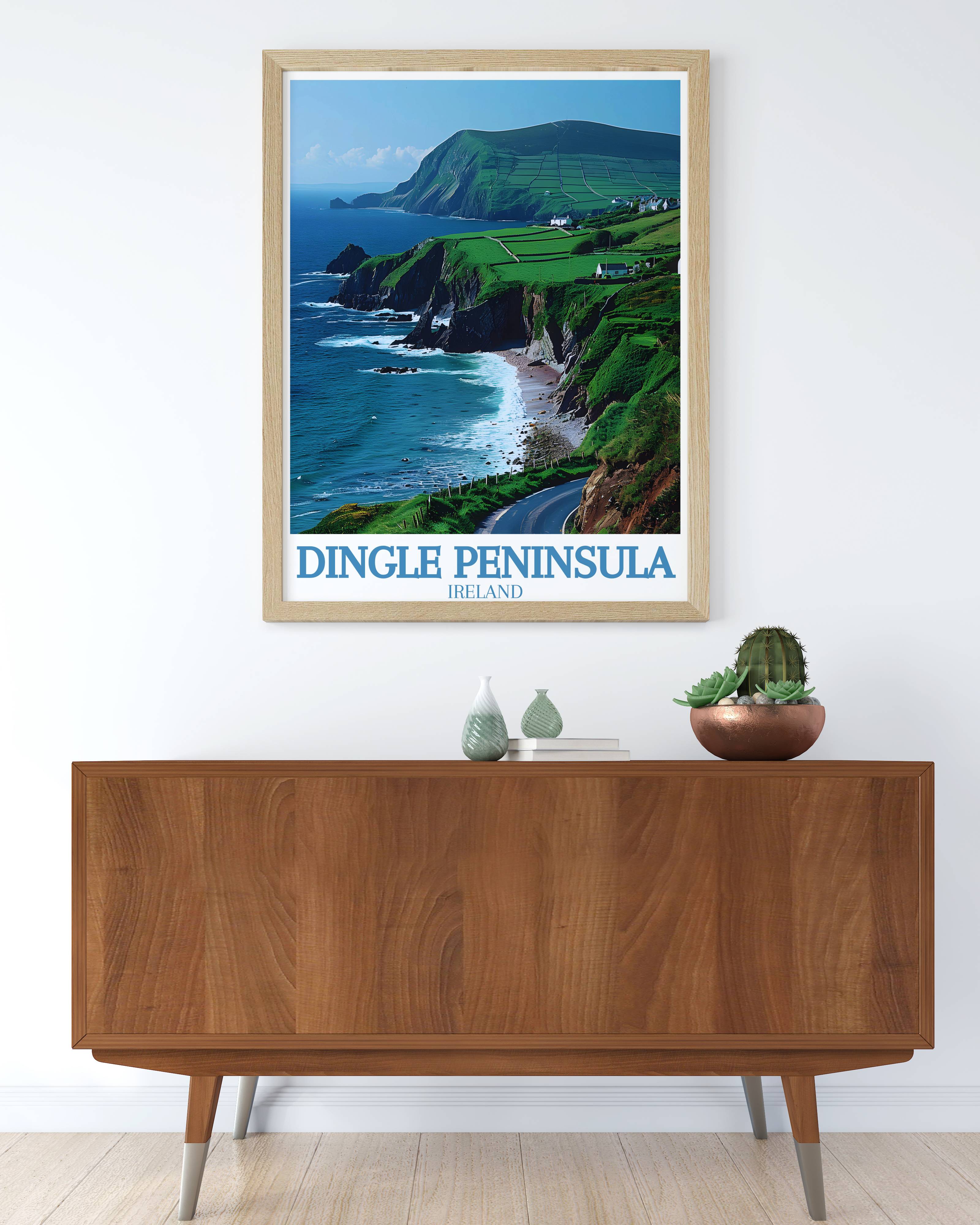
The Peninsula Landmark by Landmark — Six Poster Art Subjects
No other Irish peninsula of this size concentrates so many visually distinct poster art subjects. These six are the ones the collection builds around.
Slea Head
Wild Atlantic Way • Most DramaticThe southwestern tip of the peninsula, where the road curves around a cliff edge above the Atlantic and the Blasket Islands appear offshore like sleeping whales. Slea Head in mist, in storm light, in the golden hour of a Kerry evening — each condition produces a completely different composition, all of them extraordinary.
Dunquin Pier
Most Westerly Pier • Iconic StepsThe long concrete pier descending in a series of switchback steps down the cliff face to the water, with the Blasket Islands directly across the sound. The most photographed pier in Ireland and one of the most visually striking poster art subjects on the entire Wild Atlantic Way.
Gallarus Oratory
700 AD • Dry StoneAn early Christian corbelled stone structure built without mortar around 700–1000 AD, still perfectly weathertight after twelve centuries. In a field above the harbour with the Atlantic visible behind it, Gallarus carries a visual simplicity and historical depth that few Irish subjects can match.
Dingle Harbour
Painted Houses • Funghi’s BayThe colourful harbour front — boats on the water, painted facades, the church tower rising above the roofline, Mount Brandon visible on clear days across the bay. The warm, inhabited, human-scale composition that balances the wilder subjects of the outer peninsula.
Mount Brandon
952m • Saint Brendan’s MountainThe second-highest mountain in Ireland and the highest outside Macgillycuddy’s Reeks, sacred to Saint Brendan the Navigator who is said to have set off from its western slopes to discover America in the 6th century. Viewed across Brandon Bay, it forms a dramatic horizon above the peninsula’s northern shore.
Conor Pass
Ireland’s Highest Road PassThe narrow mountain road that crosses the spine of the peninsula at 456 metres — Ireland’s highest mountain pass. The view from the summit, looking down to Dingle town and bay on the south side and Brandon Bay on the north, is the most comprehensive panoramic composition of the entire peninsula.
| Subject | Location | Character | Best Style | Best Format |
|---|---|---|---|---|
| Slea Head | SW Peninsula | Wild & Cinematic | Bold graphic, vintage poster | Large canvas |
| Dunquin Pier | West tip | Architectural & Quiet | Fine line, photography | Framed A1 |
| Gallarus Oratory | North coast | Ancient & Minimal | Fine line, watercolour | Framed print |
| Dingle Harbour | Town centre | Warm & Vivid | Mid-century graphic | Framed A2/A1 |
| Mount Brandon | North ridge | Epic & Sacred | Landscape, vintage | Panoramic canvas |
| Conor Pass | Mountain spine | Panoramic & High | Graphic, photography | Canvas panoramic |
Dingle • The Peninsula by Foot
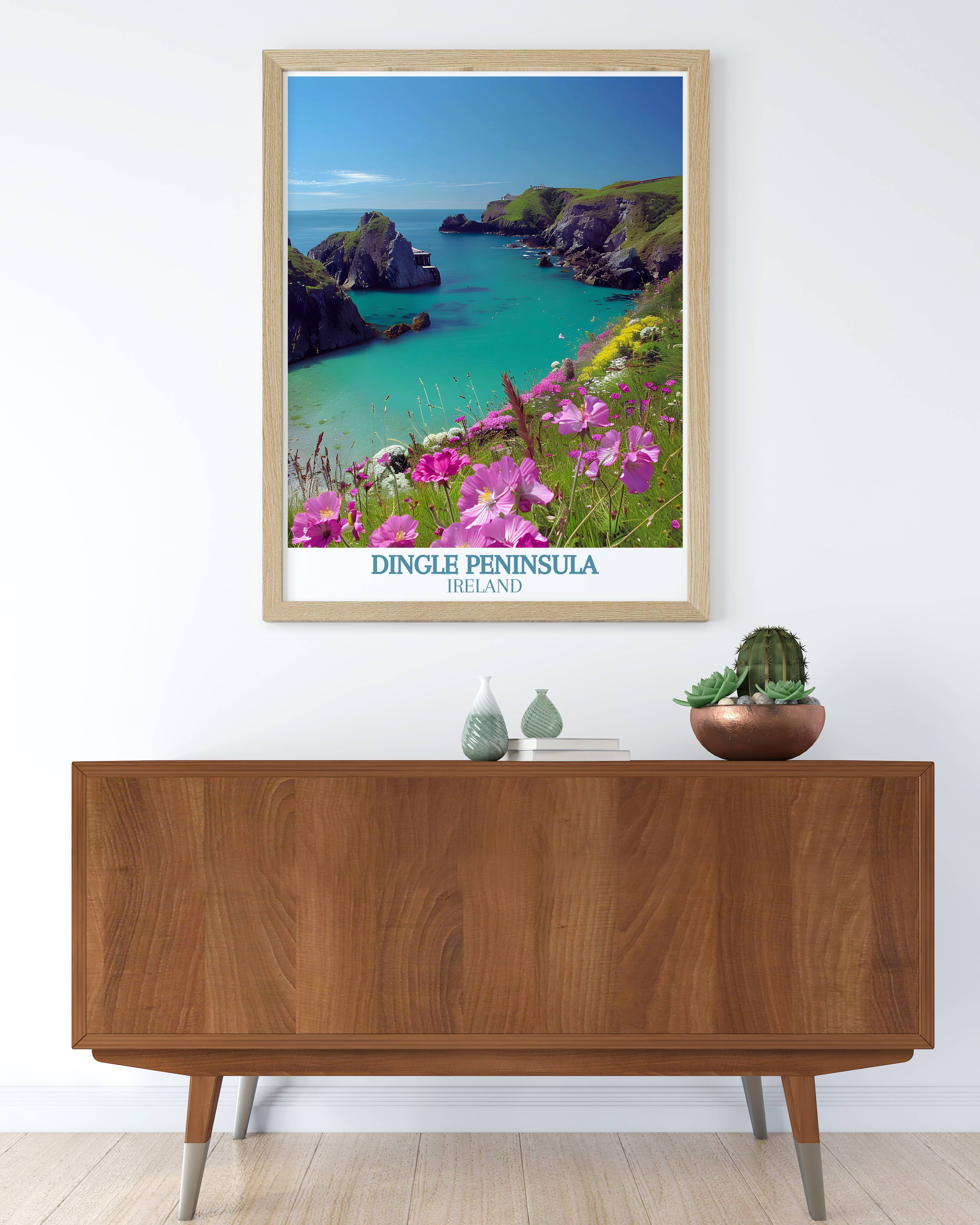
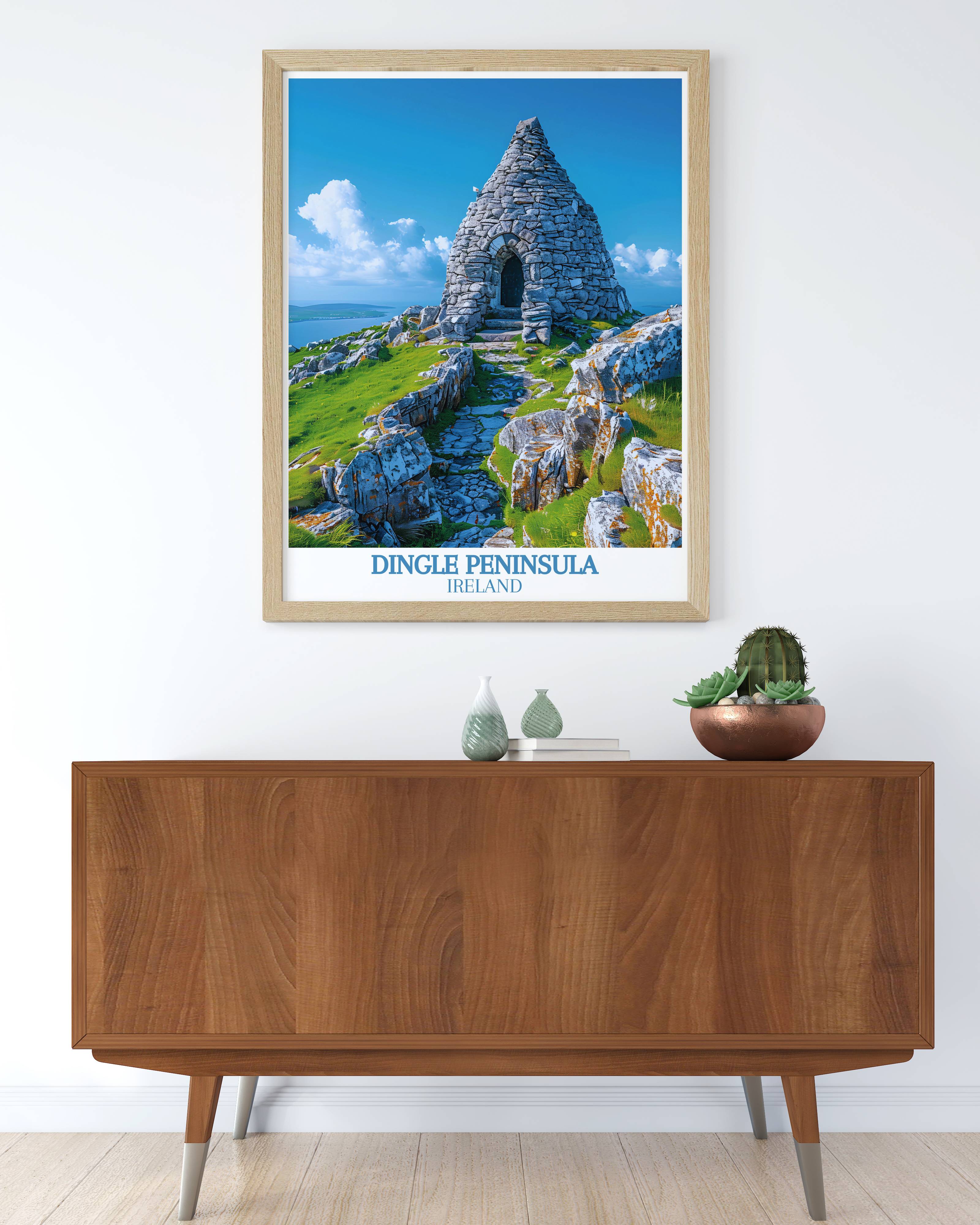
Dunquin Pier and Gallarus — The Two Subjects Every Kerry Lover Needs
Dunquin Pier is not the kind of subject you stumble upon. It requires intent — a decision to drive to the very end of the road, to park above the cliff face and then walk down the switchback concrete ramp to the slipway below. When you arrive, you understand the decision immediately. The Blasket Islands are right there across the sound, so close it seems impossible that they are uninhabited, so beautiful it seems impossible that they were abandoned — as they were, in 1953, when the last twenty islanders were evacuated to the mainland.
The composition from the pier is one of the finest coastal subjects in Ireland: the angular geometry of the steps leading down to the sea, the dark Atlantic, the islands in the middle distance, the Kerry sky above. In a fine line print it is architectural and spare. In a vintage travel poster style it is bold and cinematic. Either way, it carries a weight of Atlantic melancholy and beauty that is specific to this particular corner of Kerry.
Gallarus Oratory is the other essential subject. Built in the corbelled dry-stone tradition, without mortar, it has stood for somewhere between one and thirteen centuries — the dating is contested — and its walls are still perfectly waterproof. The building is roughly the shape of an upturned boat, which may not be coincidence given its proximity to the sea and the maritime tradition of early Celtic Christianity. From outside, it is one of the purest and most satisfying architectural forms in Ireland: small, perfect, ancient, still. As a poster subject it works in any style — the building’s inherent geometry makes it adaptable to fine line minimalism, bold graphic simplicity, and atmospheric watercolour equally well.
Dingle • Fungí • The Heart of the Harbour

Fungí — Dingle’s Most Beloved Resident
Between 1983 and 2020, a bottlenose dolphin lived in Dingle Harbour. He had arrived alone, taken up residence in the bay, and decided apparently to remain — for thirty-seven years. His name was Fungí, pronounced Fung-ee, and it means mushroom in Irish. Nobody knows why he came or why he stayed. He swam with boats, with divers, with kayakers, with swimmers brave enough to enter the Kerry Atlantic. He became the most famous wild dolphin in the world.
He disappeared in October 2020. The whole town grieved. The harbour tour boats that had taken visitors out to swim with him for nearly four decades had to find new purpose. A life-size bronze statue was installed at the pier. And a particular quality of magic that Dingle Harbour had possessed for a generation was quietly changed.
A Dingle harbour print that captures the atmosphere of that bay — the painted boats, the mountain behind, the open water — carries Fungí in it whether or not he appears explicitly. For anyone who visited Dingle during those thirty-seven years and swam with him or watched him from the pier, the harbour image is inseparable from the memory of what made it extraordinary. These are the prints for those people.
Dingle • The Irish Diaspora • Heritage Gifts
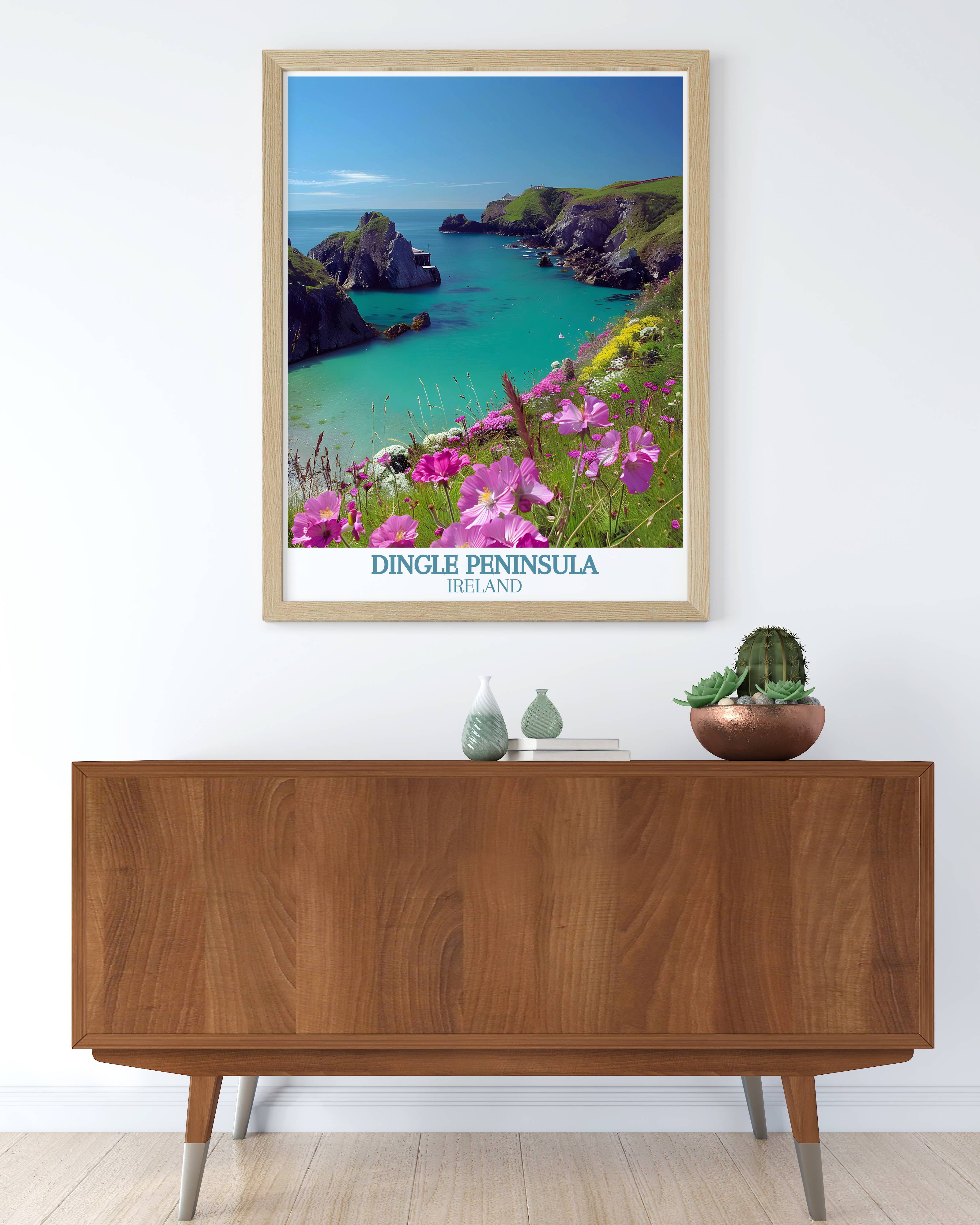
Kerry Prints for the Irish Diaspora — Eighty Million People, One Peninsula
There are approximately five million people in Ireland. There are an estimated seventy to eighty million people worldwide who claim Irish heritage — in the United States, Australia, Great Britain, Canada, Argentina, and across Europe. Of these, Kerry holds a particular place. County Kerry sent some of its largest emigrant communities to Boston, New York, and Chicago in the famine decades and after, and many of those families have maintained a specific, named connection to the peninsula down through the generations.
A Dingle peninsula poster for these families is not decoration. It is a naming of a place they have heard about, or visited, or are trying to return to. Slea Head on the wall of a Boston apartment is a connection. Dunquin Pier in a Melbourne kitchen is a statement of where you come from. Gallarus Oratory in a London office is the twelve-hundred-year-old continuity of a culture that survived everything — including emigration.
These prints also make some of the most considered gifts available for anyone with an Irish connection. A birthday, a Christmas, a housewarming for someone who has just moved into their first home — a framed Dingle harbour print says something specific about what you know of them and what you understand about what Kerry means. That precision is what separates a good gift from a generic one.
In the Home


Where a Dingle Print Belongs
Dingle prints suit a wider range of interiors than most Irish landscape art, because the peninsula’s visual character moves between wildness and warmth depending on the composition. The Slea Head cliff road in bold graphic style belongs on a feature wall — it makes a statement. The Dingle harbour in mid-century pastel tones suits a kitchen or a living room where the warmth of the painted facades adds colour without drama. Gallarus in fine line works in a home office or a study, where the quiet antiquity of the subject suits a room for thinking.
Natural wood frames are the most sympathetic choice for the warm Kerry palette — the greens and golds and the particular terracotta of the painted houses. Black frames suit the bold graphic Atlantic compositions, where the contrast of the Kerry landscape against a strong sky needs a frame that holds its own.
Print Formats

Choosing the Right Format
Every design in this collection is available in three formats. For the Slea Head cliff road panoramic and the Conor Pass summit view, large canvas captures the full scale of the landscape. For the Gallarus Oratory fine line and the Dingle harbour compositions, a framed print in natural wood is the most harmonious choice.
📄
Unframed Prints
Ships rolled in crush-proof tubes. Frame yourself for the exact finish your interior needs. 220gsm archival matte paper, 75+ year fade-resistant inks. The most flexible and most gift-friendly option — rolls flat for posting anywhere in the world.
Paper220gsm Archival Matte
Ink75+ year fade-resistant
Best forDiaspora gifts • gallery walls • framing
🖼
Framed Kerry Wall Art
Ready to hang. Hardware pre-attached. UV-resistant acrylic glazing. Black, white, natural wood, or walnut. For the warm Kerry green, ocean blue, and harbour colour palette, natural wood frames are the most sympathetic — they echo the character of the landscape without competing with it.
FramesBlack • White • Natural Wood • Walnut
GlazingUV-resistant acrylic
Best forHeritage gifts • instant display
🎨
Canvas Prints
Gallery-wrapped on solid pine stretcher bars. Ships assembled and ready to hang. Canvas is ideal for the Slea Head cliff road and the Conor Pass panoramic, where the horizontal scale of the Wild Atlantic Way landscape needs room to fully breathe.
Canvas400gsm Cotton, Pine Frame
SizesA3 to A1 & panoramic
Best forStatement walls • panoramic Atlantic views
Shipping: All prints ship worldwide. UK and Ireland 3–5 days. Europe and USA 4–8 days. Worldwide up to 12 days. All orders tracked. Custom Dingle print requests: contact us here.
Frequently Asked Questions
Dingle Ireland Posters — FAQs
Common questions about Dingle Ireland posters, Kerry travel prints, and Irish wall art.
What are Dingle Ireland posters?▾
Dingle Ireland posters are wall art prints depicting the Dingle Peninsula in County Kerry, Ireland — Slea Head, Dunquin Pier, Gallarus Oratory, Dingle Harbour, Mount Brandon, the Blasket Islands, and the Wild Atlantic Way coastline. Available in vintage Kerry travel poster style, fine line illustration, and bold graphic compositions, in framed, canvas, and unframed formats shipped worldwide.
What makes Dingle such a great travel poster subject?▾
Dingle Peninsula concentrates an extraordinary range of poster art subjects into a small area: a 1,300-year-old dry stone oratory, the most westerly pier in Ireland, a cliff road above the Atlantic, Ireland’s highest mountain pass, a harbour painted in colours only Kerry achieves, and the Blasket Islands visible offshore. The particular quality of Kerry light — changeable, luminous, and capable of extraordinary colour — makes every one of them painterly in a way that few other destinations manage.
Who was Fungí the Dingle dolphin?▾
Fungí was a bottlenose dolphin who lived in Dingle Harbour from 1983 until his disappearance in October 2020 — 37 years of daily presence in the bay, swimming with boats, divers, and swimmers. His name (pronounced Fung-ee) means mushroom in Irish. He became the most famous wild dolphin in the world and drew visitors to Dingle from every country. For anyone who visited Dingle during those decades and swam with him or watched from the pier, the harbour holds a particular memory that goes beyond landscape.
What is Gallarus Oratory?▾
Gallarus Oratory is an early Christian dry-stone structure on the Dingle Peninsula, built around 700–1000 AD, one of the best-preserved corbelled stone buildings in Ireland. It has stood without mortar for over a thousand years, its walls still perfectly weathertight. In a field above the harbour with the Atlantic visible behind it, Gallarus carries a visual simplicity and historical weight that few Irish subjects can match.
Are Dingle prints good gifts for the Irish diaspora?▾
Yes. With an estimated 70–80 million people worldwide claiming Irish heritage, a Dingle peninsula poster is one of the most personally meaningful gifts available. Kerry holds a deep place in Irish-American, Irish-Australian, and Irish-British identity — the Slea Head cliff road, Dunquin Pier, and Gallarus connect directly to a specific place that many diaspora families trace ancestry to. A framed Dingle harbour print carries a weight of connection that no generic Ireland merchandise can replicate.
What is the Wild Atlantic Way?▾
The Wild Atlantic Way is a 2,500km coastal driving route along the western seaboard of Ireland. The Dingle Peninsula section — Slea Head, Dunquin, the Blasket Sound — is among the most dramatic and most photographed stretches of the entire route. This is the point where the road ends, the continent ends, and only the Atlantic remains between Kerry and North America. It is the most sought-after section for Dingle Peninsula travel poster art.
Do Dingle Ireland posters ship internationally?▾
Yes. All prints ship worldwide. Unframed posters roll in protective tubes; framed wall art ships boxed with corner guards. UK and Ireland delivery 3–5 days. Europe and USA 4–8 days. Worldwide up to 12 days. All orders include full tracking from dispatch.
Are prints available framed?▾
Yes. Every design is available unframed, framed in black, white, natural wood, or walnut, and as gallery-wrapped canvas. Framed prints arrive with hardware pre-attached and ready to hang. For the warm Kerry palette, natural wood frames are the most sympathetic. For bold graphic Atlantic compositions, black frames give the strongest contemporary result.


Dingle.
The Edge of Europe,
On Your Wall.
The Edge of Europe,
On Your Wall.
Original Kerry travel prints, framed Irish wall art & canvas — Slea Head, Dunquin Pier, Gallarus Oratory and the Wild Atlantic Way. For the diaspora and everyone the peninsula has captivated. Ships worldwide.
© MapYourDreams — All Rights Reserved
Let customers speak for us

This Akiba Shrine at Ukeji print by Hiroshige has such lovely perspective and depth, very typical of his best landscape work. The colors are rich without being overly saturated, keeping that classic ukiyo-e feel. Print quality is excellent with sharp detail throughout the composition. A beautiful addition for anyone who loves traditional Japanese landscape prints.

The ghost of Okiku print rounds out our little collection of Hokusai's supernatural series and it is just as striking as the others. The detail in the figure and background elements has translated really well into print. It is a fantastic, moody addition for anyone who loves Japanese folklore art. Great quality for the price.
Rounds out our little collection of supernatural prints and it's just as striking as the rest. Detail in the figure translated really well into print. Moody, fantastic addition for folklore art fans.

Simple, elegant, full of quiet detail in the feathers and posture. Fits perfectly among our other bird and flower prints. Natural, well-balanced coloring, crisp overall.
This 1834 hawfinch print by Hokusai is simple, elegant, and full of quiet detail in the bird's feathers and posture. It fits perfectly among our other Japanese bird and flower art prints. Print quality is crisp with natural, well-balanced coloring. A lovely, understated piece for anyone who loves Hokusai beyond just the Great Wave.

The ghost of Oiwa print is hauntingly beautiful, one of Hokusai's most famous supernatural pieces and this print captures the eerie detail really well. It is not for everyone but if you love classic Japanese ghost art, this is a fantastic addition. Print quality is sharp with rich, dark tones throughout. A striking, unusual piece for a gallery wall with personality.
Hauntingly beautiful, one of the most famous supernatural pieces Hokusai created. Not for everyone but a fantastic addition if you love it. Rich, dark tones throughout, sharp printing.

Properly eerie in the best way, perfect for fans of Hokusai's darker supernatural side. Linework in the ghostly figure preserved impressively well. Fun conversation piece in our home office.
This ghost of Kohada Koheiji print is properly eerie in the best way, perfect for anyone who loves the darker, supernatural side of Hokusai's work. The linework detail in the ghostly figure is impressively preserved in the print. It has become a fun conversation piece in our home office. A great pick for fans of Japanese ghost stories and yokai art.

Delicately rendered, full of soft color and fine detail. Gentle energy on our bedroom wall now. Smooth printing with beautifully balanced pastel tones.
The peonies and canary in this 1834 Hokusai print are so delicately rendered, full of soft color and fine detail. It brings a lovely, gentle energy to our bedroom wall. Print quality is smooth with beautifully balanced pastel tones. A gorgeous, less common choice from Hokusai's flower and bird series.

Wonderful energy and movement, a less common piece which felt special to own. Crisp, museum-poster quality throughout. Great pick for collectors wanting to go beyond the usual Hokusai favorites.
This 1822 Harugoma print by Hokusai has such wonderful energy and movement, it is a less common piece which made it feel special. Print quality has that museum-poster crispness I was hoping for. It looks great alongside our other Japanese art prints in the hallway. A great pick for collectors who want to go beyond the usual Hokusai favorites.

So much richer in person than I expected from a reproduction. Foam and Mount Fuji details come through beautifully. No color bleeding, highly recommend for fans of this legendary piece.
This 1831 edition style print of the Great Wave off Kanagawa by Hokusai is stunning in person, so much richer than I expected from a reproduction. The details in the foam and Mount Fuji in the background come through beautifully. Print quality is excellent with no color bleeding. Highly recommend for anyone who loves this legendary piece of Japanese art.